
Nativity Lecture 2018 03

Son in a Strange Land

God picked Egypt and Nazareth for Christ. Who wants to live in either Egypt of Nazareth? Or who would choose to begin public life in a desert? We will find the young saviour doing all of that and hanging out with the right crowd and growing up with grace.

Familiar with the strange

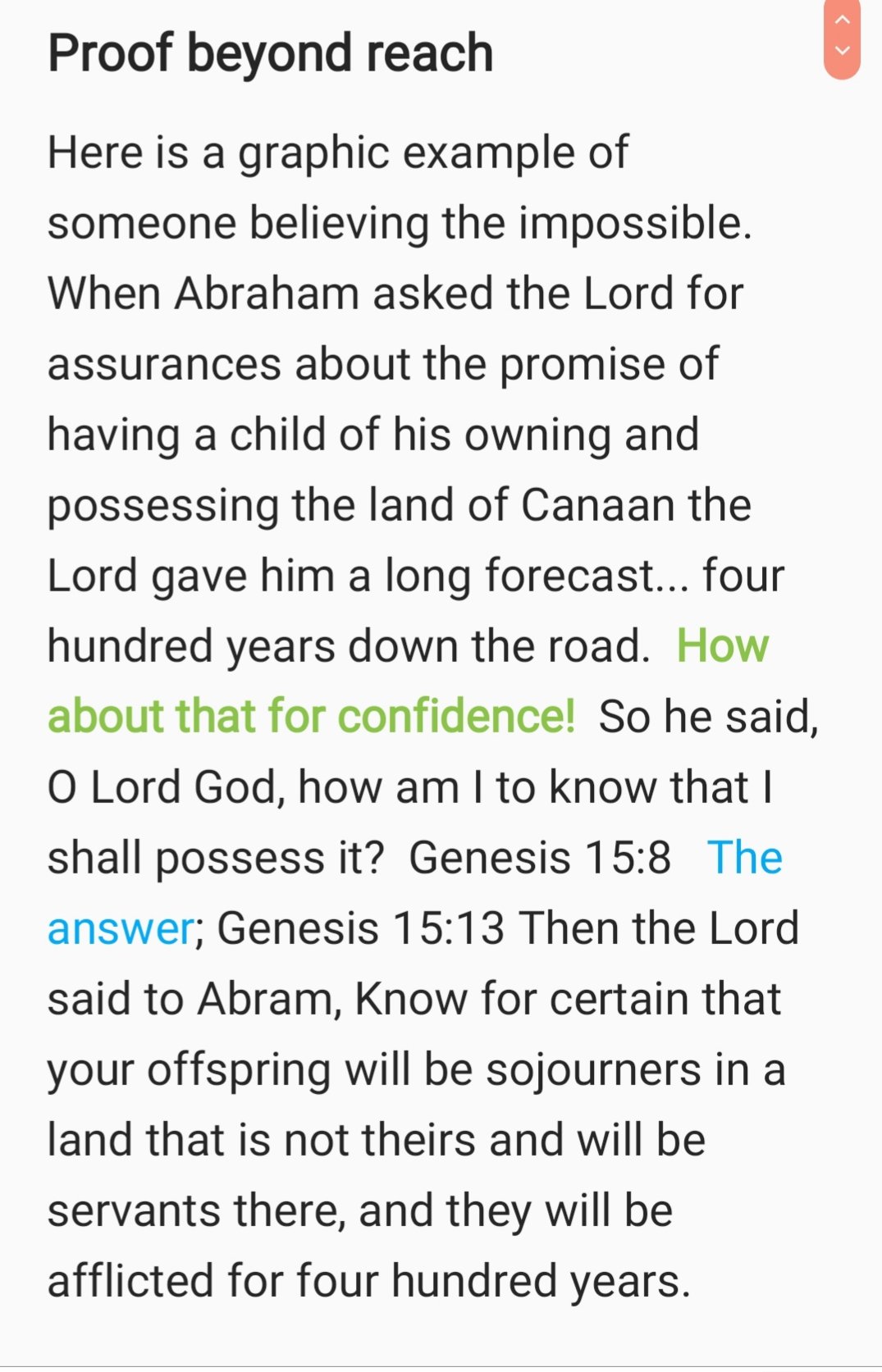
The flight to Egypt was only the beginning of peculiar or unusual things. Jewish people are familiar with peculiar and strange, and definitely with foreign. Their very existence began not in Canaan but in Egypt, and the proof, as requested by Abraham, that there would be a Jewish people, was the 400 year bondage in Egypt (Gen. 15:8-13)

  • But the LORD has taken you and brought you out of the iron furnace, out of Egypt, to be a people of his own inheritance, as you are this day. Deut 4:20
  • “He found him in a desert land, and in the howling waste of the wilderness; he encircled him, he cared for him, he kept him as the apple of his eye. Deut. 32:10

Exile and Return

God exiled the sons of Israel for 70 years, and on their return they were diligent to re-institute the Mosaic economy. The Jewish people were the first unwitting “globetrotters” and the Christ-child is destined to purposefully be in every nation, every home, touching every family by the end of the age.

In Nazareth of Galilee, the young Christ would have seen Gentiles living in their own skin. The prophet calls Galilee “of the Nations”, in other words, Gentile Galilee (Isaiah 9:1-2). Christ’s contemporaries figured that nothing good could come from this place. One of the first disciples asked out loud, “… Can anything good come out of Nazareth?” Philip said to him, “Come and see.” John 1:46

It was there in this despised place that the bright light from heaven shone and there the Son was given.

For to us a child is born, to us a son is given; and the government shall be upon his shoulder, and his name shall be called Wonderful Counselor, Mighty God, Everlasting Father, Prince of Peace. Isa 9:6


Nativity Lecture 2018 The price of escape -02

Now when they had departed, behold, an angel of the Lord appeared to Joseph in a dream and said, “Rise, take the child and his mother, and flee to Egypt, and remain there until I tell you, for Herod is about to search for the child, to destroy him.” Matt 2:13

A considerable period separates the magi’s visit and Herod’s rampage from Joseph’s dream. Matthew uses the term pai-DI-on (paidion, paidivon) for all of the stories of the Christ-child including the return form Egypt. It is the common word for child or young person. Luke however, a bit more precisely describes the unborn child in the womb and the manger as a BREfos, brevfw” ( 1:41, 1:44, 2:12, & 2:16). The Christ-child is no longer a baby.

The escape journey to Egypt is not happenstance. The writer ties the saviour’s residence in Africa to a prophecy from Hosea 11:1. The instructive dream and the intervention of angels are not new phenomena. They continue as part of the heritage of believers. The Lord promised (Joel 2:28ff) to give dreams to his people and a host of experiences of the people God interacts are introduced by angels.

The Christ child quickly became a refugee. Mary got to move her family, while the mothers of the Bethlehem region would would see their treasures cruelly destroyed. The megalomaniac king Herod gave orders for every boy-child under two years old to be killed. It was a high price to pay for the saviour’s safety, but it shows that with all of heaven’s resources available the subjects of God’s regard do not always stand to fight and confront the threats.

The villages of the region became one mass of murder, mourning, and burial. Bethlehem and its surrounding villages and towns may have had a few dozen babies under 2 years old, but the deliberate murder of babies is also the topic of prophecy. Jeremiah records weeping in Rama for children by someone named Rachel. Putting the Hosea and Jeremiah prophecies together we get Rachel representing the mothers and Israel representing the Son of God, as is to say the nation laments the loss of children.

It may be that the word spread quickly and other male babes were saved, but the Christ-child was not to stick around. There might even have been people who would later remember the disappearance of Mary’s family coinciding with the death of Bethlehem’s babies.

The visit of the magi and the escape to stay in Egypt fill out the cosmopolitan environment in which Christ-child began life and set the pattern for association with the Saviour of the world and the cost of being a disciple. The pilgrim mold is cast even before he is unveiled at the Jordan by John the Baptist. Having such a turbulent beginning and living in different cultural settings prepares the Saviour for his mission. Salvation is free and its very nature yanks us out of our comfort zone and thrusts us into the life of a pilgrim whether or not we recognize the price paid by others for our seeking the king.

Nativity Lecture 2018 01 Finding the King

We have come close one more time to the end of the year and the frenzy or merriment and giving seems to take over the planet. We know that hearts are not usually going through any radical change because by January the giving stops as if there were no people to love. The king whose story we assume feeds the myth of the jolly elf and his magical assistants is everybody’s king all year round. My hope for all of us is that soon we will find and follow him.   We hope these essays will spark our thirst for life

It is a full-bodied picture that emerges of the Son of God when we read of his arrival and infancy. The Christ-child was more like many of us than we can imagine. We know with certainty that Christ was born into trouble, a king for sure, and sought by all, once his identity is affirmed. It is still an exciting venture, to make one’s mind up and go find the king. It is not as if there are no stars in our sky to tell us that the king has arrived, was born, and that it is not a secret where to look for him, and we should go find him.

God-with-us and God-like-us

Sometimes we hear the objection that heroes in the Bible are unrealistic but the Chris-child is more like us in the 21st century than we would like to believe.

He had family like ours, with one notable exception. The man and the woman were uniquely molded, she for childlike faith that she would have a baby with no male contribution, and he for keeping the family secret. “My soul magnifies the Lord … so let it be to me” was Mary’s song and prayer, and Joseph loved her and refused to expose her to public scrutiny. We would not go looking for a king if we learned that he was not the child of his mother’s husband.

The unveiling of the just. A man and a young girl

Now the birth of Jesus Christ was on this wise: When as his mother Mary was espoused to Joseph, before they came together, she was found with child of the Holy Ghost.

Matt 1:18

The two served God with mercy and sensitivity.

And her husband Joseph, being a just man and unwilling to put her to shame, resolved to divorce her quietly.

Matt 1:19

King in trouble from birth

Here comes trouble:

Having heard about the king Herod and all Jerusalem was troubled.

Matt 2:3

If the monarch is troubled when a new king is born should not the whole population also quake? The king himself – baby Yeshua – is destined for unimaginable trouble and conflict, and especially at the conclusion of his visit.

“WHERE IS HE” BECOMES THE OPERATIVE QUESTION

The pressing demand for each one to whom this news comes – these tidings of a king’s birth – is WHERE IS HE? We have to come into contact with the king. Find him and worship. It must have been difficult for these first-comers to drag themselves away from the king, both as newborn and as declared Lamb of God. When the first disciples asked the adult Christ for his address he had been to Egypt and Nazareth, two places of no distinction for a Jew. If they could have seen the total residence history of the king it would include and finally on the road, and practically homeless.

And he went and lived in a city called Nazareth, so that what was spoken by the prophets might be fulfilled, that he would be called a Nazarene.

Matthew 2:23

The next day again John was standing with two of his disciples, John 1:35; and he looked at Jesus as he walked by and said, “Behold, the Lamb of God!” John 1:36; The two disciples heard him say this, and they followed Jesus. John 1:37; Jesus turned and saw them following and said to them, “What are you seeking?” And they said to him, “Rabbi” (which means Teacher), “where are you staying?” John 1:38; He said to them, “Come and you will see.” So they came and saw where he was staying, and they stayed with him that day, for it was about the tenth hour. John 1:39; One of the two who heard John speak and followed Jesus was Andrew, Simon Peter’s brother. John 1:40;

WHERE IS HE? DO WE NOT WANT TO KNOW?

The Late Great Ingrate

… the anger of man does not produce the righteousness of God. James 1:20

Angry people -sow chaos. Insatiable persons thrive on endless complaints. A deprived family finds comfort in hostility and competition. A warring tribe traffics in death.

Righteousness ( greatness) cannot be these two

  1. getting the things we want or need
  2. giving in love

But they had a wanton craving in the wilderness, and put God to the test in the desert; he gave them what they asked, but sent a wasting disease among them. Psalms 106:14-16

A lost race – a saviour awaits

If on the Sabbath a man receives circumcision, so that the law of Moses may not be broken, are you angry with me because on the Sabbath I made a man’s whole body well? John 7:23

And let the peace of Christ rule in your hearts, to which indeed you were called in one body. And be thankful. Colossians 3:15

Love one another

James talks about the royal law and there seems to be no kingdom attached to that law. He is talking about the Sinai Covenant. Loving as I love myself is a nebulous and low profile pursuit. It has become an idol if we think it meets God’s design.

This is my commandment, that you love one another as I have loved you. Greater love has no one than this, that someone lay down his life for his friends. John 15:12-13

The Great Bewitching Hijack

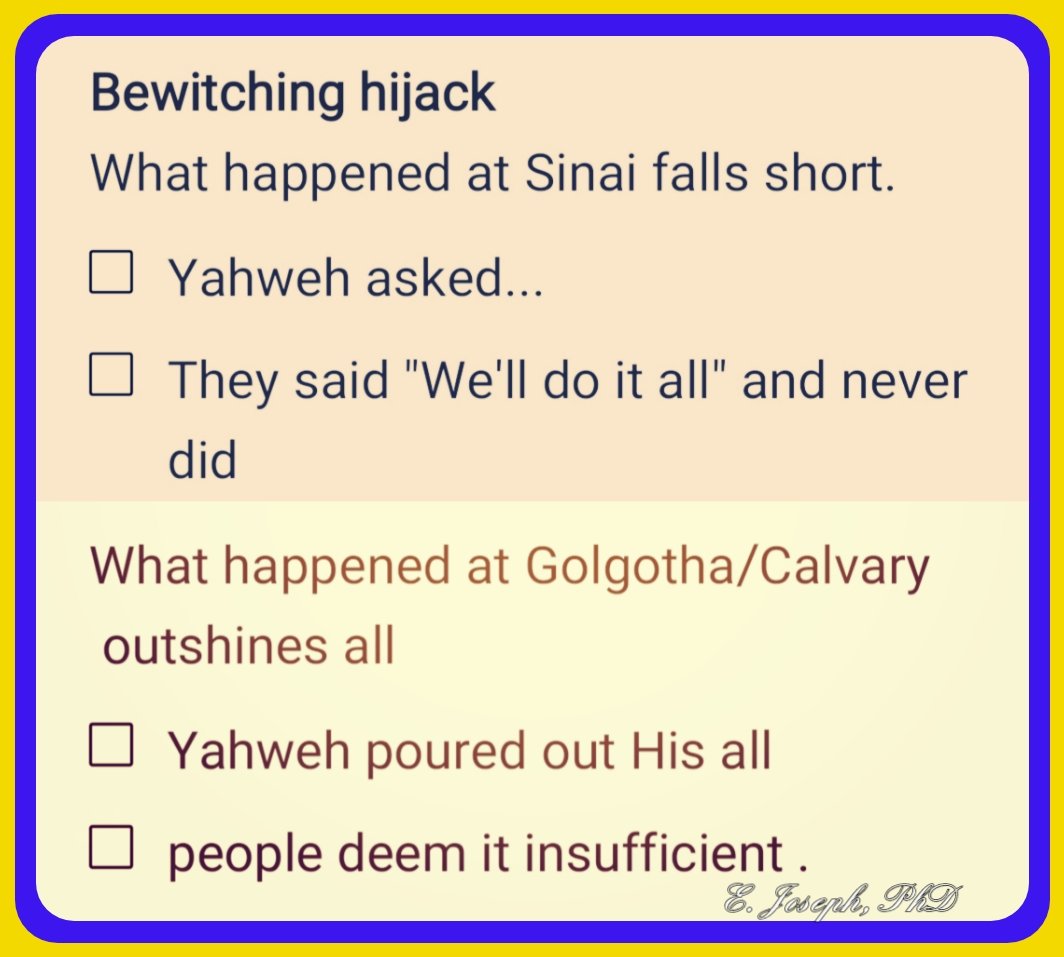
The disssatisfaction associated with Sinai and Calvary flows from our desire to please ourselves. In the Sinai situation the people faced the music unadvisedly and advisedly.

The people promised unadvisedly

They were not going to keep the law and they were not even going to get past the First Commandment (which outlawed other gods). Compliance was really not happening.

The people protested advisedly:

There was no heart available to contain what God’s will was. The only hearts that could receive God’s will are the ones that receive the Holy Spirit since Christ died.

The sons of Israel were right when they asked Moses to shuttle back and forth and tell them what Yahweh had to say.

As Christians, we take on a life of promising because we can guarantee nothing. We rely on God’s promises. Here too our expressions go off the rails and (back) into the box of death.

Every time they see “I will” they are in quicksand territory.

Some deadly examples:

  1. I will bless the Lord at all times, his praise shall be continually in my mouth. Psa. 34:1
  2. My heart is steadfast, O God! I will sing and make melody with all my being! Psalms 108:1
  3. Then I will go to the altar of God, to God my exceeding joy, and I will praise you with the lyre, O God, my God. Psalms 43:4

These I wills are not ordinary promises and predictions: they are a kind of intense and hyper-respectful way to plead or make a request. These should be translated “let me sing” and “let me play” and “Let me come”. This form of address seems to ask the Lord for the okay to sing and play (for example in declaring his righteousness) but notice what people do. They take these as promises and then tell themselves things like the following – and the end up the same mire as the Sinai crew.

  • I will abc with my whole being
  • I will xyz all the time

These exhausting activities – of doing anything incessantly or without fail – are small peanuts compared things like circumcision, unruly children, ethnic bigotry, church discipline and unpretentious love.

All of the turmoil and confusion in Christianity has to do with the fact that people are trying to escape from loving one another the way God loves us. They have made up all kinds of conventions and regulations but they will duck the pattern of us loving people the way God loves us. Few want to do it even when they say that it is the way of light.