Clarity is knowing that you know and that nothing is outside of God’s goodness net. Sometimes we find an expression that evokes a sigh or a bewilderment so profound one asks “says who?”
The God of the Bible has his ways, entirely different to ours. His thoughts are not our thoughts, and yet what he shares with us is consistent with his ways and his primary thoughts towards us. He makes paths for us to walk, and he allows us to make paths for our feet, crooked or straight. We should not however confuse unbending with constricted, straight with strait.
‘For I know the plans that I have for you,’ declares the Lord, ‘plans for welfare and not for calamity to give you a future and a hope. (Jeremiah 29:11)
Why the Islamic deity is on a straight path is beyond me.
Indeed, I have relied upon Allāh, my Lord and your Lord. There is no creature but that He holds it by its forelock [i.e., controls it]. Indeed, my Lord is on a path [that is] straight.— Saheeh International
The straight path in both the Law and the Gospel is the path assigned for humanity. Even when the Word of God was made flesh, he was not on the same path as those that were following him. The confusion is deafening, and that does not even address who the speaker is in that verse.
For my thoughts are not your thoughts, neither are your ways my ways, saith the Lord. For as the heavens are higher than the earth, so are my ways higher than your ways, and my thoughts than your thoughts. (Isaiah 55:8-9)
On the roads we tread, long, short, winding, upwards or downwards God says he has us. On the mountain or in the valley, our God has us.
“Free for real” is a proposition that people complicate with common sense, traditions, and the rules and regulations they think are necessary under all circumstances. The Son makes people free on the basis of his decree, confirming that freedom is not related to any constitution or body of laws. Christ liberates people without reference to the law of God/Moses. The certainty of real freedom as proposed by the Lord Christ puts pretend and ritual freedom, the stuff of which levitical ministry was made of, in clear contrast. This means that the recognition that “… through Him everyone who believes is freed from all things, from which you could not be freed through the Law of Moses.” (Acts 13:39, NASB) may have emboldened early believers like James (our Lord’s brother) to try to bring circumcision and dietary restrictions. The truly free person does not have to keep proving his liberty to anyone. He is free because of Christ’s exclusive intervention. The liberated simply decides to abide (meinete) in Christ’s words, and his freedom is assured. Most people who have recognized their need for salvation will tell us that their satisfaction wasvinconsistent with chains of pride, playacting “family”, and a meager awareness of service.
Tribal tensions
It is a sad state of affairs when the people who believe that Yeshua is God’s Son and Saviour of the world think that their badges and books, prophets and patriarchs, seers and scribes are some kind of super currency in God’s ledger. The son and slave, and house reference in John 8 was Yeshua’s way of alerting his audience to the fatal disease of playing the tribe card.
God allowed both Sarah and Abraham to play their cards in the dust up over Ishmael and Isaac. She recommended that Abraham sleep with Hagar. Then Abraham cooperated with Sarah’s expulsion of Hagar from the household.
“So Sarai said to Abram, “Now behold, the Lord has prevented me from bearing children. Please go in to my maid; perhaps I will obtain children through her.” And Abram listened to the voice of Sarai.”
Genesis 16:2, NASB
5) And Sarai said to Abram, “May the wrong done me be upon you. I gave my maid into your arms, but when she saw that she had conceived, I was despised in her sight. May the Lord judge between you and me.” 6) But Abram said to Sarai, “Behold, your maid is in your power; do to her what is good in your sight.” So Sarai treated her harshly, and she fled from her presence.”
Genesis 16:5-6, NASB
Yahweh’s view of the family
18) And Abraham said to God, “Oh that Ishmael might live before You!” 19) But God said, “No, but Sarah your wife will bear you a son, and you shall call his name Isaac; and I will establish My covenant with him for an everlasting covenant for his descendants after him. 20) “As for Ishmael, I have heard you; behold, I will bless him, and will make him fruitful and will multiply him exceedingly. He shall become the father of twelve princes, and I will make him a great nation.” (Genesis 17:18-20, NASB)
Paul’s insight on the issue of son and slave is riveting. He flips the son/slave rhetoric between Sinai and Calvary, assigning Hagar’s slave experience to the Israelites and the Sinai covenant and he assigns the promise and the global agenda to Abraham’s descendants who follow Abraham’s example of believing God’s offer.
22) For it is written that Abraham had two sons, one by the bondwoman and one by the free woman. 23) But the son by the bondwoman was born according to the flesh, and the son by the free woman through the promise. 24) This is allegorically speaking, for these women are two covenants: one proceeding from Mount Sinai bearing children who are to be slaves; she is Hagar.” (Galatians 4:22-24, NASB)
So now there are two great nations coming from Abraham’s immediate family. Whence then the tension and the animosity between ishmaelites and Israelites? Should not there be a measure of respect and love? I guess not before hearts can confess that all men are equal before God’s saving grace. So what do we think and what do we do with this son-freedom?
Thinking and doing
Treating the action option first, we get ahead of the crowd with our appreciation of God as exclusive and inimitable Father. Most people are comfortable saying that they have a God, a prophet, a master, or some kind of caretaker, but not many are willing to say that God is their father or that they are God’s child. There is not much to think about when one considers how important sons are to their fathers, in the Bible and outside it. Given the historic and documented fatherhood of good men and scoundrels we accept the proposition that God sees humans as potential children of his.
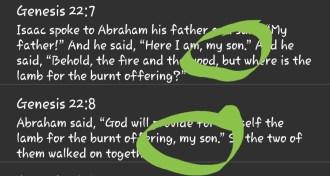
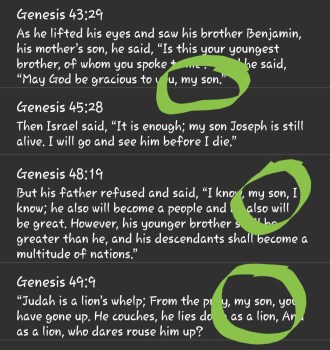
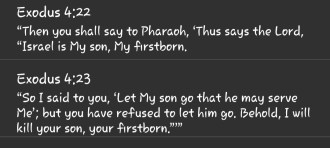
Skip past Abraham if you dare Significant patriarchal example Even people facing execution are called “son”A soundrel calls the hated “son”Jealousy should not prevent recognition of the family idea between God and Israel No angel or official has the privilege of a son
The test to which we might want to subject those who call themselves sons of God should prioritize engagement in God’s business. Reading what precedes Luke 2:48 to see what being in the house and free can look like.
48) When they saw Him, they were astonished; and His mother said to Him, “Son, why have You treated us this way? Behold, Your father and I have been anxiously looking for You.” 49) And He said to them, “Why is it that you were looking for Me? Did you not know that I had to be in My Father’s house?” (Luke 2:48-49, NASB)




 Life is Fun, But Not a Joke