A Kiss to Remember

They were having dinner with their most highly esteemed friend and he looks at them and says “One of you will betray”. Naturally, in the mode of Adam, each of them peppers him with “Not me, right?” The one among who knew that he had hatched a betrayal plot also presses his innocence. The kindness of the highly esteemed friend does not allow him to cover up the facts, so he tags the traitor. He even tells him its time to go to it. It is clear that his affection for the traitor is unshaken, and this comes to light like a supernova in the garden where the traitor’s mannerism betrays his deep affection for the highly esteemed friend: a kiss to remember.

The agreed upon sign was a kiss.

Now the betrayer had given them a sign, saying, “The one I will kiss is the man; seize him.” (Matt 26:48) [I will kiss, fileso, from fileo, fee-LAY-o, I kiss, I am fond of]

In the garden, however, the traitor does not merely kiss the highly esteemed friend, he throws himself into the sign. It is not a peck on the cheek, nor even a smack on the lips. Matthew describes it with katafileo, an all-out display of affection. He got his hands into it with a hug, tightly clasping the highly esteemed friend. He may have had his hands on the cheeks of his friend’s face. It was a kiss full of gusto.

And he came up to Jesus at once and said, “Greetings, Rabbi!” 
And he kissed him. ( Matt 26:49)

SKIPPING BREAKFAST AND OVERLOOKING DINNER

Two surprises leap at me from Hebrews 13:16, one marvelously comforting and the other shocking and disturbing.

The first is the layered excuse – deliberate omission – that people were making. They kept skipping their roles as do-gooders and sharers. They covered this up with “I forgot”.
The second is that they/we are not allowed to keep this practice of not doing the sacrificial things, the priestly service.

To these two shortcomings Paul offered:

  • you must not keep forgetting to do well and share your gifts
  • doing good and sharing are God-pleasing (living) sacrifices

Do not neglect to do good and to share what you have, for such sacrifices are pleasing to God.

Living sacrifices from a living priesthood.

Get on with doing good and sharing

Recant!

Might our right to speak our minds in public be under threat? How is today’s world different from the world into which Moses, Isaiah, or John (the writer of the book of Revelation) were thrust. There is always pressure to recant and the believer must be certain of his stand so as not to be swayed by spurious theories or death threats.

A fully formed mental attitude is in the works for each believer and an easy compliance with standards – whether many or few – will fall short. We love standing on the shore and expect to be called mature fishers. Conversely, we pick extreme fruit from the tree of popular theories and invite all kinds of attention, but when the critics and the paparazzi show up we play the persecuted victim card.

There will be massive deflections from the faith when the pressure to join the popular and approved religion takes over. Many who can’t get enough of church and the business generates will deny Christ.

  • They told us a man cannot be God.
  • They said a man cannot forgive sin

The incredibly virulent violence that shakes our world in the 21st century, ravaging people in their worship places is familiar to every religious group. We cannot spin this fact. Our refuge is the truth and our commitment to it.

Christ is Lord and the only Saviour and we had better be aware that pressure to deny Christian doctrine has been the practice of both Christians and Jews.

Changing our minds about Christ in favour of a common message which will include law-abiding pride amounts to recanting in absence of a threat

Whose Glasses Did you Use?

A popular saying goes “One person’s garbage is another’s treasure” and it applies to things we love to hate and and things we hate to love. The last time I jumped in front of a speeding train to save someone the observers thought I was joking. Getting into someone’s shoes may help us understand their experiences but we never see their thoughts and our understanding will rarely be the same.

We dare not call someone’s possession garbage, nor do we muster up the courage to say we see diamonds whenever a humble chunk of carbon presented to us. It is so tempting to jump into the Biblical narratives on the side we perceive as the good guys, the winners, and the heads, as if God has programmed everyone to be loving, conquerors, heads, and faithful witnesses. We end up wearing glasses that lie to us, and that distorts the realities that we need for personal growth.

Acts 19:13-16

Then some of the itinerant Jewish exorcists undertook to invoke the name of the Lord Jesus over those who had evil spirits, saying, I adjure you by the Jesus whom Paul proclaims. Seven sons of a Jewish high priest named Sceva were doing this.

But the evil spirit answered them, Jesus I know, and Paul I recognize, but who are you? And the man in whom was the evil spirit leaped on them, mastered all of them and overpowered them, so that they fled out of that house naked and wounded.

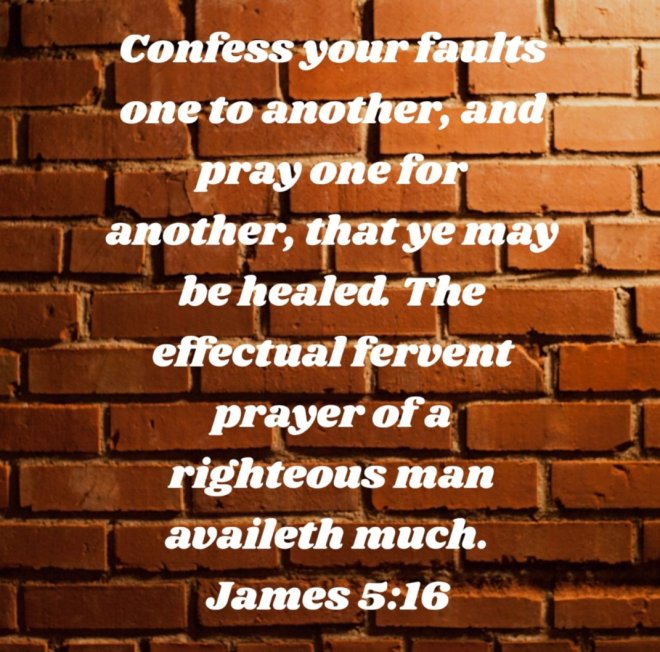
Confess with caution and confidence

There is an extreme expectation that can arise from sayings like this, not to mention the anguish of betrayed confidences, the sheer wall of insensitivity, cold hearts and a lack of humility and empathy. Some people in the crowd lose their interest in our welfare when our weaknesses and errors come to light. Be careful to whom you “confess”.

One to another

If people think that God’s pardon is a loan imagine in what esteem they hold their own readiness to forgive. However well-intentioned a mutual confession might be, in a group or one-to-one, the chances of gossip and apathy are high.

Confess only to significant others, only to people whose likeness to Christ you have confirmed.

Do not give dogs what is holy [special to you], and do not throw your pearls before pigs, lest they trample them underfoot and turn to attack you. Matthew 7:6

From the House to the Street

When Jesus had washed their feet and put on his outer clothing, he reclined again and said to them, “Do you know what I have done for you? You call me Teacher and Lord — and you are speaking rightly, since that is what I am. For I have given you an example, that you also should do just as I have done for you. John 13:12‭-‬13‭, ‬15 CSB

https://bible.com/bible/1713/jhn.13.12-15.CSB

This dramatic example of caring for each other hardly happens at our daily dinner time. We seem to have less time for preparing healthy meals, and we increasingly want everything “now”. In the world of close relatives – people authorized to be or allowed in our homes – washing the feet follows the kiss at the door (we also take the coat or outerwear), and if we are observant, we might offer the guest a quick touch up to their appearance, some oil for the hair and an extra pillow or too so they can “make themselves at home”.

A lot of loving has a reason

The three hard realities of caring are kiss, water, and oil. A woman leads the way! I am not surprised.

Then turning toward the woman he said to Simon, “Do you see this woman? I entered your house; you gave me no water for my feet, but she has wet my feet with her tears and wiped them with her hair. (Luke 7:44) You gave me no kiss, but from the time I came in she has not ceased to kiss my feet. (Luke 7:45) You did not anoint my head with oil, but she has anointed my feet with ointment. (Luke 7:46) Therefore I tell you, her sins, which are many, are forgiven—for she loved much. But he who is forgiven little, loves little.” (Luke 7:47)

The scope of humble service

Maybe “caring for one another” can be restricted to disciples, so we can absolve ourselves of being this nice to strangers or non-intimates. If that is to be sustainable, we have to realize that the lordship of the great Footwasher finds no parallel in our relations with anyone. A host would kiss his guests at the door, have his servant make the guest comfortable, if not basking in the abundance of generosity, and acceptance. We also have to recognize that we are not authorized to do washes that have any cleansing efficacy. We do not wash feet in order cleanse people from sin.

Taking it to the street

We may be ritually washing the feet of people who are woefully unaware of the glory of loving humble service, yet we do it. We may be habitually missing scores of foot-washing opportunities because we do not care for people the way Christ cared for Judas. Our xenophiobic DNA is killing us.

Grace is a thing we get and yet we contort ourselves to avoid being kind to sinners. Away from the ritual washing of clean feet we realize that the Master’s example is an attitude fix, not a thing to do now and then. Let us take it to the “others”: the Hindu, Muslim, Jew, Buddhist, knowing full well that we are not bosses, only devoted and persistent slaves.

Half-baked, Half-saved

Salvation is a gift, and even when we preserve or endure there is no credit to us. People are always distracted by self- importance: what we can say and what we can do. Nothing we can do seems to be anything more than a filthy rag, but there is always faith. Half-saved is what results when people do not believe, and half saved is lost.

Then they said to him, What must we do, to be doing the works of God? Jesus answered them, This is the work of God, that you believe in him whom he has sent.

John 6:28-29

Faith needs no partner

If we see the way Christ paved for us we will recognize that tales about our performance and acquisitions – obedience and knowledge – are lies that keep us pinned under the burden of darkness. Work hard at believing the truth because it frees completely. This is not a halfway business deal. Christ frees us as we take God’s work seriously and without distraction.

Hiding in a rock

Fanny Crosby, a prolific writer who was blind, is likely in the top tier of influential women and kingdom-of-God workers. If you are interested you can look at the songs this messenger has contributed to the church’s witness and see how she, unsighted, looks forward to seeing and even revels in visions of the present condition.

Here is Isaiah sounding off about interpersonal refuge. It is a marvelous highway which may seem to make skilled and conscientious Christian leadership unnecessary but it is another layer of investment in everyone.

Each will be like a hiding place from the wind, a shelter from the storm, like streams of water in a dry place, like the shade of a great rock in a weary land. Isaiah 32:2

  1. Fanny was a hiding place
  2. Fanny was a shelter.
  3. Fanny was a stream of water in a dry place
  4. Fanny was a shady rock in a weary land

Rocky VII

No sequel of Fanny or apostle Peter is imminent; no copy of Yeshua or you exists, but we all have a great rocky destiny, in the fashion of St. Peter (Rock, Kefa, Petros). Fanny was convinced her sight would improve.

All the things that Fanny saw in her wonderful Saviour she was privileged to be. We are privileged to be. This means that each of us has the potential to be rocky residences and rocky witnesses. Shifting sand and pebbles do not work.

Oh the height and depth of mercy

Oh the length and breadth of love

Oh the fullness of redemption

Pledge of endless life above