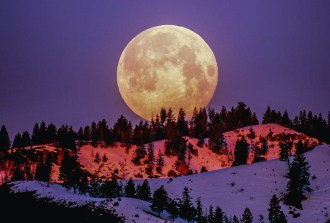
Sundown and moonrise

The day Christ died was a Passover.  He did not die over a period of seven days.  He was, according to the eyewitnesses to his life, the Paschal Lamb. His herald announced him as God’s Lamb (John 1:29). The man from Nazareth was the Paschal Lamb. Passover or Pesach is a single day, and it corresponds astronomically to the day/night the Sons of Israel departed Egypt with Joseph’s bones.  It is an annul sign or feast. Christians have tagged the Sunday that follows the first  full moon after the spring equinox. Then they backtrack try to Friday and call that Good Friday. If there is such a thing as holy time it will be marked by supernatural means. Passover is always the 14th day of Nisan, and coincides with the full moon of the first month. The day Christ died people are likely to have seen the sun disappear around 3pm, and the full moon rise shortly after sunset.

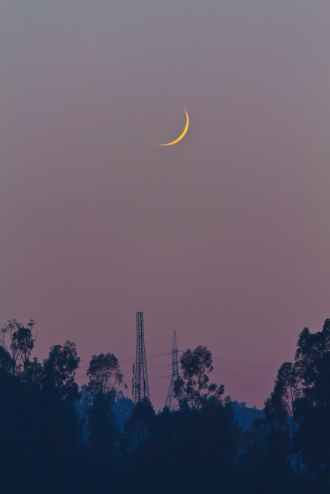
Still miles apart

If you lived in ancient Israel, the first and last days of each month would feature a moon like the first two in the set (above). In the middle of month, around the fourteenth day, the sky moon would be full. The moon and sun have assigned tasks of marking off day, night, signs, and seasons (Genesis 1:14). So, since the moon is essential for calculating when to keep the Passover Feast, Despite sharing two common sets of books harmony is hard to find. Good Friday, Ramadan and Passover are unlikely bedfellows.

Messiah is not diplomatic about festivals and hoopla

Jews and Christians are still miles apart over what Passover means.  The violence on Temple Mount shows the galaxies between Jews and Muslims.   Maybe Arabs and the Jewish people will do business and exchange vacation spots but sitting down to celebrate life and divine revelation together is next to impossible. Of course there are many ways to express cultural solidarity, such as folk lore, traditional and regional practices. Spiritual enlightenment and divine revelation are not possible grounds for harmony between mosque, synagogue and church. The sun has set and the moon is now fully exposed as not a “great” source of light. All the patriarchs, prophets and kings are losers, and if you ask Yeshua, he will tell you that they are all guilty of posing with someone else’s property.

Clearly not mud; what gives?

He who dwells …shall abide cannot be talking about the same action.  Yashab is clearly resident, and lûn is definitely stay overnight.  The person who is currently using the divine hiding place –  the seter, סתר – as dwelling place or, frankly, home,  will [try to] make himself stay overnight.  It is obvious that the seter is not the usual residence: it is the place where one takes cover, or hides.  Perhaps “bunker” is another way to think of the secret place or shelter.  The shadow of El Shaddai is also both a substantial permanent cover and a temporary refuge.  Compare the wings of a bird as the place where fledglings find protection (Deuteronomy 32:11  and Matthew 23:37).  “Abide” seems to be unrealistic when both places are incidental locations of refuge.

“He who dwells in the shelter of the Most High Will abide in the shadow of the Almighty.”

Psalms 91:1

The temporary and permanent elements of “shadow” are evident

  • A ROOF IS A SHADOW/ SHADE. “Now behold, I have two daughters who have not had relations with man; please let me bring them out to you, and do to them whatever you like; only do nothing to these men, inasmuch as they have come under the shelter of my roof.” (Genesis 19:8, NASB).  Lot had offered his house for an overnight stay, saying, “Now behold, my lords, please turn aside into your servant’s house, and SPEND THE NIGHT, and wash your feet; then you may rise early and go on your way.” They said however, “No, but we shall SPEND THE NIGHT in the square.” (Genesis 19:2, NASB)
  • A TREE PROVIDES SHADE.  ‘All the birds of the heavens nested in its boughs, And under its branches all the beasts of the field gave birth, And all great nations lived under its shade.” (Ezekiel 31:6, NASB)
  • WINGS PROVIDE SHADOW/SHELTER “How precious is Your lovingkindness, O God! And the children of men take refuge in the shadow of Your wings.” (Psalms 36:7, NASB)
  • YAHWEH HIMSELF IS THE BELIEVER’S SHADE. The Lord is your keeper; The Lord is your shade on your right hand.” (Psalms 121:5, NASB)
  • THE Divine SHADOW IS A SOURCE OF HOPE  “Those who live in his shadow Will again raise grain, And they will blossom like the vine. His renown will be like the wine of Lebanon.” (Hosea 14:7, NASB)

When I look into many of the popular sayings in the Bible I particularly like finding a reason to say “Hey, what’s going on here?” Well, this “dwelling” and “abiding” in Psalm 91 looks kind of fishy and at least your curiosity has to be aroused seeing synonyms like DWELL and ABIDE appearing in this song from the 10th century BC.  Neither dwell nor abide are 21st century usage.  Now it is clear that ABIDING for lûn could not be the intended meaning over against dwelling (yashab), because abiding is really the overnight experience rather than a daytime homey experience.  When strangers arrive in the daytime one offers them shelter, footcare and food (Genesis 18:1ff).  When strangers arrive in the nighttime one offers them shelter, footcare,  food and a sleepover (Genesis 19:1ff).  If DWELLING in Psalm 91 is residing then a sleepover – ABIDING –  is nothing.  The reflexive stem (hithpael) of the verb tells us that the person who experiences a daytime welcome and secretive hospitality will make himself a sleepover guest.

“HE WHO DWELLS in the shelter of the Most High WILL ABIDE in the shadow of the Almighty.”

Psalms 91:1

Walk right in, sit right down, sleep over if you wish

From a homey and sheltering welcome to a sleepover seems to be a better transition and a certified improvement over dwelling and abiding.

A tiny mind indeed

That a large volume of almost 1000 pages can be reduced to 100 pages and be called someone’s mind is shocking to me.  When I realized how few speeches by His Imperial Majesty were available a generation later I had to question how we can say we love humanity and education. The book of sayings I knew was a university publication.  That book was the size of my English version of the Mishnah.   A tiny booklet titled “The Wise Mind of His Imperial Majesty Haile Selassie” shows how impoverished the Pan-African or Rastafarian can be.  The book I knew contained complete speeches.  The contents of that book were a  huge mine of imperial majesty and it is the book I credit with  a most important passage for a dispersed African.

When I was a young Rastafarian I had access to a book of speeches by his Imperial Majesty Emperor Haile Selassie I.  At the time I was wading through this large volume I had already been reading the Bible regularly and was particularly doing so in those late teenage years.  The book helped to transform me into a committed and passionate pan-africanist, but it also brought me to my faith and my love of writing. 

A volume in circulation

In any case this book was borrowed from one or two mentors and beloved brothers in those days, either one brother Haile or brother King Frank-I.  The book did its rounds, reaching even the semi-literate brothers. The man I met from gobbling up that book was a person of unusual depth of fatherliness, a man of wisdom and displaying the capacity to care tenderly.  The book gave the benefit of context – date and occasion – and fulsome speeches, not merely handpicked sentences. I cannot believe that a tiny booklet can be a healthy source of the wisdom of the highest crowned head of his times. There has to be more, lest we think of this giant of humanity, His Imperial Majesty Haile Selassie I, as a tiny mind indeed.