Cutting straight and chopping off

One of the meanings of the action addressed in the exhortation from Paul to Timothy in 2  Timothy 2:15 is often overlooked.  Accurately handling comes from orthotomeo ortho-taw-MAY-o; the ortho portion gives us the RIGHT part of the action.  Ortho also appears in Orthodox, meaning right opinion.  The other half of the word means cut.   So, putting the two pieces together we have the instruction from Paul to Timothy indicating cutting something in the proper way. 

Be diligent to present yourself approved to God as a workman who does not need to be ashamed, accurately handling the word of truth. (2 Timothy 2:15)

I have thought of this action as that performed by a joiner, a worker in wood, who cuts things precisely so that they can fit together by simple gluing. But let’s not take that gluing too far.  It has now dawned on me that the proper work recommended by Paul would involve separating things that are not necessary. 

For example, taking the Lord’s teaching in John chapter 4:21-24, one must cut away anything related to either mountain, Jerusalem or Gerizim. 

21) Jesus said to her, “Woman, believe Me, an hour is coming when neither in this mountain nor in Jerusalem will you worship the Father. 22) “You worship what you do not know; we worship what we know, for salvation is from the Jews. 23) “But an hour is coming, and now is, when the true worshipers will worship the Father in spirit and truth; for such people the Father seeks to be His worshipers. 24) “God is spirit, and those who worship Him must worship in spirit and truth.” (John 4:21-24)

Worship in spirit and in truth does not need any mountain anywhere, needs no dedicated priesthood, no sacred objects, and no fixed times or seasons.

A second example, takes the Lord’s role as the prophet,  and parks any prophetic saying once an instance of Yeshua’s utterance on the same matter is available.  So there you have it:  “properly handling” or “correctly handling” or “rightly dividing” as the King James version says, most certainly includes chopping things off.

In outstanding contrast

Bible study comes in various forms and they are supposed to all end with glorious edification, but leave it to me to affirm that they also end with catastrophic confusion, regret,  and at least a good feeling. 

A scholarly Bible study 🎯

A Bible study attended by scholars is bound to be a furious rollercoaster ride with no apologies.  The theologians’ Bible study will have that Columbo effect; always “one more thing”.  This means that conclusions are likely to be multilayered, appear unnecessarily complex, and will be off the beaten path.  While the proverbial forest waits for discovery the scholars are paying attention to every little tree.  One last thing; the study is not guaranteed to end with the dart to bullseye.

A speculative inspection Bible study

A group of friends enter a wooded area, and the sound of birdsong immediately fills their ears. The blind one points over to the left, saying “House Finch”, and one lady raises her binoculars and says “There he is”, and everyone in the group turns to see a splash of red. The person who had never seen a House Finch had learned what sounds one makes. Bird watching, or more precisely, birding, can be satisfying without eyes. Bible study without eyes, or ears or lips intersecting with the Sacred Text is just not happening.

Photo by Chris F on Pexels.com

Reading repeatedly

Reading the Bible is a priority we should never overlook, as some do, opting to elevate commentaries and unhinged visions.  We should be especially wary of narratives of  Yeshua’s life coming from people who have no respect for the integrity of the four Gospels and who have no idea that plain sayings in the Bible cannot be better explained by anything beside the Bible, even when one reads over and over again.

People in New Testament times were sure of what they were reading or hearing quoted from the Bible.  The  Bible was in their language!  Explanations serve to bring the Messiah into the picture, not to clarify what the authors intended their readers.  The only way to thoroughly understand the Bible is to read it, but please do not keep making  the mistake of imposing English, French, or Spanish grammar on its sentences. When they repeated the reading it was for the purpose of emphasizing something that stood out, and in Hebrew and greek, every word stands out.

The authority of Scripture is locked up in the Scripture in languages that are foreign to most.    The impressions that come when the reader seeks understanding should never be mistaken for interpretation, because interpretation is going to be confirmed by what is written.  A person can foam at the mouth, fall down in a trance, become stuff as a plank and say God showed them x, y, and z but the proof that such manifestations are unreliable is extent in the embarrassing doctrines and practices that distinguish many faith groups of the twenty-first century.  The discovery of genuine Messianic doctrine will continue to elude us as long as people  try to pass each other off as teachers.

as also [Paul]  in all his letters, speaking in them of these things, in which are some things hard to understand, which the untaught and unstable distort, as they do also the rest of the Scriptures, to their own destruction. (2 Peter 3:16, NASB)

The doctrine of Christ will always stand in stark contrast to the distortions of law and Levitical processes, because Christ and Moses (and the prophets) are not gospel partners.  The contrast could not be clearer.

Another apalling greedy grab

It is incredibly shortsighted for a man who has been a pastor for decades to not recognize that people die, that people are born blind for God’s glory, that  people try to force God’s hand, and people openly oppose God without affecting God’s manifold wisdom and greatness.

“Oh, the depth of the riches both of the wisdom and knowledge of God! How unsearchable are His judgments and unfathomable His ways!”

Romans 11:33, NASB

Limits, freedom, and absolutism have no comfortable human oasis, because the mystery of Christian faith revolves around the Infinite God clothing himself with finite humanity, all the way to death as a criminal.  They have found a hotel in the triumphalism of the evangelical world. Let us be honest about the fact that “all things are possible”, “what government can achieve”, and “what God can do” are the engines of authentic faith in much of North America.  One is consequently led to consider that God has no sovereign will and that he can be thwarted, while believers with the right stuff can have a “life without limits”.  I suppose the  narratives of patriarchal fellowship with God have nothing to do with human beings like Abraham and Joseph whose lives and expectations could  not be more expressive of heads and tails.  It is easy to forget that the first man did his own thing with massive effect on all humans, and we raise our hands in praise that God had a plan to deal with his rebellion instead of pointing the finger at Adam and Eve.  Psalm 78:41 is a unique piece of songwriting and using it to sell a book about people limiting God is defiling, dangerous, and probably an important part of the demonic doctrine strategy.

I recently heard an American marketer named Wommack on television delivering a spiel about limiting God.  On the route to selling a book or some other useless trinkets the blind guide ripped up God’s sovereignty by consulting a dictionary to define it, painted himself as a witness to a resurrection from the dead in his family (an event for which there was no evidence), and provided yet another face in the line up of tricksters feeding off of gullible people. 

It was clear from the beginning that here was another 20 minutes of utter blah, blah, bull.  If Wommack wanted to know what the once-used term tawah meant he could have consulted a lexicon of Hebrew words, and after finding that it is not found elsewhere he could have turned to the Bible with which the Lord Christ was familiar, the Septuagint.  He would have seen that “limit” is not what tawah means.

Sorry, sisters and brothers!  There is no formula. God lets his friends die, and lets enemies live.  That is what sovereignty looks like.

The term in Psalm 78:41 translated as tempted (KJV), offended (NET) is a hapax legomenon.  It appears once in Scripture.  The Jewish people reading the Septuagint would have known that the context of the story told in Psalm 78:41 and 56 is about unbelief and God’s grief.  Let it be absolutely clear that The Exodus as a narrative must include the fact that the generation that departed Egypt died in the wilderness.   Therefore what the people did to God in that entire episode was to grieve God, test God, showed him their unbelief and complaining (Exodus 16:7, 8, 9, 17:3, 7, Numbers 14:2, 29,  Deuteronomy 1:27, 6:16, 9:7, 8, 22).   Pardon me, Mr Wommack and followers.  No one limits God, and anyone who tries that will find himself (a) in close contact with God’s goads, like Saul of Tarsus, and (b) hopefully a vessel that serves the Sovereign Lord.

“καὶ ἐπέστρεψαν καὶ ἐπείρασαν τὸν θεὸν καὶ τὸν ἅγιον τοῦ Ισραηλ παρώξυναν.” [from paroxuno, I irritate,  I provoke]

Psalm 78:41 LXX

Paroxuno appears in Hosea 8:5 and Zechariah 10:3 with reference to divine anger being aroused.  There is no basis for “limit”.  God’s sovereignty is also not limited by human resistance and to suggest it is to show that our salvation is not, in our elevated view of ourselves,  God’s sovereign act.

Regarding Yahweh’s assertion of owner’s right let Scripture speak to the issue of whether God can be limited.  Let’s face facts: Adam walked into death and God covered him. Is not the Pharaoh of the Exodus – a type of the Evil One – an example of how human willpower when exercised against God’s intervention is a scrawny feather in the wind? So who do we charge with limiting God when every descendant of Adam resists God’s will and are subject to his control of the faucet of mercy. 

15) For He says to Moses, “I will have mercy on whom I have mercy, and I will have compassion on whom I have compassion.” 16) So then it does not depend on the man who wills or the man who runs, but on God who has mercy. 17) For the Scripture says to Pharaoh, “For this very purpose I raised you up, to demonstrate My power in you, and that My name might be proclaimed throughout the whole earth.” 18) So then He has mercy on whom He desires, and He hardens whom He desires. 19) You will say to me then, “Why does He still find fault? For who resists His will?” 20) On the contrary, who are you, O man, who answers back to God? The thing molded will not say to the molder, “Why did you make me like this,” will it?” (Romans 9:15-20, NASB)

The last time you told the truth

Are you a spinner or interpreter of the Gospel? Do you expect my biblical truth to be contemporary propaganda or timeless teaching approved by the Anointed God? Did the world change when we started? Where will the world be when we end? The truth can never again be separated from the man Messiah Yeshua.

Salvation preacher’s courage A to Z

Without the Nazarene, the Anointed God, our truth-speaking is a lot of clangjng symbols, useless noise, and hot air.

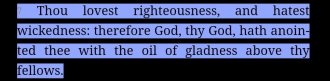
Psalm 45:7

Hebrews 1:8-9